Hong Kong’s geopolitical journey to remain a major seaport
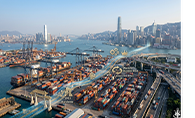 Hong Kong is no exception from being affected by geopolitics. After the panic of the 1997 handover to China subsided, the feared collapse of freedoms did not immediately materialise. Life continued much as before, and Hong Kong retained its crown as the world’s busiest container port. Hong Kong is no exception from being affected by geopolitics. After the panic of the 1997 handover to China subsided, the feared collapse of freedoms did not immediately materialise. Life continued much as before, and Hong Kong retained its crown as the world’s busiest container port.
For more than a decade, the city thrived, with Beijing appearing to interfere as little as London once had. China, eager to integrate with the West, allowed Hong Kong’s laissez‑faire ethos to flourish, and some even speculated that by 2049, the spirit of free markets might outlast Marxist‑Leninist doctrine.
That optimism ended with Xi Jinping’s rise in 2012. Rejecting liberalisation, Xi consolidated power, purged rivals, and reasserted Communist Party dominance. His Belt and Road Initiative promised global connectivity, but at home, the erosion of rule of law became unmistakable.
“Rule of law” was redefined as obedience to state policy, undermining Hong Kong’s legal autonomy. The cracks widened in 2003, when half a million marched against Article 23 national security legislation. The law criminalised secession, sedition, and subversion - terms defined by government fiat. Free speech, once a hallmark of the territory, was suddenly precarious.
Public health crises also tested resilience. The SARS epidemic of 2003 scarred the city, but its lessons helped Hong Kong weather Covid‑19 in 2020 with less disruption than mainland China. Meanwhile, youth activism surged. Joshua Wong, just 15 in 2012, spearheaded opposition to Beijing’s “Moral and National Education” curriculum, later becoming a symbol of the 2014 Occupy Central protests demanding universal suffrage.
While political tensions mounted, Hong Kong’s maritime supremacy slipped away. Shenzhen, once a sleepy border town, mushroomed into a metropolis of nearly 14 million, overtaking Hong Kong in cargo volume. The Pearl River Delta, long a hub of global trade, now boasted multiple powerhouse ports - Guangzhou, Shenzhen, and Macau—diminishing Hong Kong’s singular role.
Hong Kong’s trajectory mirrors the ebb and flow of seaports across history. In the 18th century, Canton dominated foreign trade under the restrictive Canton System. British victory in the Opium Wars transformed Hong Kong into a free port in 1842, while the Second Opium War expanded treaty ports across China. Shanghai soon eclipsed Hong Kong, fortified by foreign concessions during the Taiping Rebellion. The Japanese occupation from 1941 to 1945 devastated Hong Kong, collapsing trade and population. Yet post‑war recovery restored its entrepot status, positioning it as Asia’s premier port by the late 20th century.
Ports rise and fall with geopolitics and economics. Montreal, once second only to New York in the Americas, now lags far behind. Once a titan of North American shipping, it has slipped to 11th or 12th place, overshadowed by Los Angeles, Long Beach, New York/New Jersey, Savannah, Vancouver, and Houston. The comparison is instructive: even the most dominant ports can fade when trade routes shift and political winds change. Likewise, Hong Kong, the world’s busiest port in 2000, has been overtaken by Shanghai, Singapore, Ningbo‑Zhoushan, Shenzhen, Guangzhou, Busan, Qingdao, Tianjin, Dubai and Rotterdam.
Despite its decline in rankings, Hong Kong remains a free port and a vital re‑export hub. Its airport is the busiest in the world for international air freight, sustaining its role as a logistics powerhouse. While no longer “top dog,” Hong Kong continues to generate wealth as a gateway between China and global markets.
Hong Kong’s story is one of resilience amid geopolitical turbulence. From colonial handover to Xi’s centralisation, from SARS to student protests, and from port dominance to relative decline, the city has endured. Its free port status remains intact, its air cargo supremacy unchallenged, and its financial clout significant. Yet the lesson is clear: seaports, like nations, are vulnerable to the tides of geopolitics. Hong Kong is no exception. |