Rotterdam deploys smart port thinking to extract all it can from the 'Blue Banana'
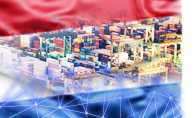 ROTTERDAM, like Hong Kong, was once the world's biggest container port, but now focuses on being the world's smartest, its container chief Hans Nagtegaal told the Hong Kong Shipping Gazette during a recent visit.
On Europe's northern range, he said, Rotterdam (annual throughput 12.3 million TEU in 2017) faces fierce competition from neighbouring harbours certainly from nearby Antwerp (10.03 million TEU).
But not only does the Port of Rotterdam see its comparative advantage as being smart, it also appreciates its unique geographical position.
That, says Hans Nagtegaal head of containers at Port of Rotterdam Authority, includes not having draft restrictions, especially at its new Maasvlakte 2 mega terminal facility.
Mr Nagtegaal also points out Rotterdam's other natural advantage of being at the mouth of the River Mass, which is the name of the Rhine as it leaves Germany and enters Holland for the sea.
This is the immediate hinterland of the Port of Rotterdam, an area called the "blue banana", also known as the European megalopolis or Manchester-Milan Axis, spreading over western and central Europe, in the shape of a banana with a consumer-rich population of 111 million.
It stretches from North Wales across Greater London into the Benelux and along the German Rhineland, southern Germany, Alsace, Switzerland and northern Italy.
While Rotterdam shares the "Blue Banana" with its larger Belgian rival Antwerp, there is also tiny Zeebrugge (1.3 million TEU a year) and even smaller Wilhelmshaven (481,720 TEU annually), to consider as well as the more substantial French Port of Le Havre (2.5 million TEU) and Germany's Hamburg (8.9 million TEU), which are not as well favoured.
The problem Hamburg faces, like all river ports, is the lack of draft. While the port has beater court challenges from environmentalists, the River Elbe can only be dredged to 14 metres. "So while 20,000-TEU ship can get into Hamburg, it cannot come in fully loaded," Mr Nagtegaal said.
Despite Le Havre's oft-made claim that it is the natural first and last port of call because it is the first ships see when they arrive and the last one when they depart, Mr Nagtegaal says it is not that simple.
Being the first and last port of call is of great value to importers who want their goods as soon as possible and equally so to exporters who want their goods on the last ship to leave the continent. Thus, such matters are subject to deliberation rather than geographical chance.
"True, dredging will increase Hamburg's capacity, but we in Rotterdam are being promoted in the carriers' schedules as first and last port of call," said Mr Nagtegaal.
"Le Havre doesn't have any hinterland. There is Paris, but that is only a little part. They don't have the 'Blue Banana', the River Rhine; we are in the best position to handle that. And if you want to maximise your carriers, maximise your loadings, you go to the port with no restrictions on draft," he said.
Like UK ports, Belgium's Zeebrugge has no draft restrictions and Germany’s Wilhelmshaven is the same. French shipping giant CMA CGM recently set up a terminal in Zeebrugge, bringing it back from the dead.
"Sometimes you think Zeebrugge is gone and then suddenly there's action again. Does Wilhelmshaven have a future? That's an interesting question.
"You see certain developments over time. Ports develop better than other ports. You can see it here in the Pearl River Delta. You saw certain ports came up big while other ports took a little bit longer to establish themselves.
"I think this is the case with Wilhelmshaven. Old habits are difficult to change. One of the things we find quite interesting," he said.
Mr Nagtegaal then told how Munich by all reason should make Rotterdam its port rather than Hamburg. "We only get two per cent of Munich's trade, the rest goes to Hamburg," he said.
But as ships get bigger, and Hamburg becomes less attractive as a result its draft restrictions, Rotterdam may well enlarge its market share of Munich traffic. "But so might Wilhelmshaven, which may develop into a major port because of its deep water, needed by ever bigger vessel sizes, and will likely have less congestion than other major ports and yet have much the same access to the 'Blue Banana'."
For the moment, Mr Nagtegaal focuses on the "smart port concept. Rotterdam and Melbourne are perhaps the most automated ports in the world. Rotterdam is actively engaged in handling the massive cargo dump that occurs every time a mega ship docks,
"We have five terminals in Rotterdam. They are run by Hutchison, DP World, APM Terminals. Some terminals are shared and are in various stages of automation," he said.
"When you ask how can we handle the big vessels when large numbers of containers arrive that is when the smart port comes in. We have a system where the terminals and the barges are in one system, which involves optimisation of planning movement.
"All of these things help get the inefficiencies out of the supply chains. And this is where we're smart and being one step ahead of the competition and able to move things fast.
"Another thing is a system called Pronto we help the carriers optimise the vessel flow through the port. So all the activities around a vessel, the terminals, the pilots, the bunker providers, the mooring men have access to the information into the same system.
Another aspect of running a smart port, with the new low-sulphur fuel rule coming in January 2020, is ensuring the Rotterdam maintains its status as a world class bunkering port. This means having ready supplies of low-sulphur fuel blends, and even rarer LNG on hand to supply ships when they need it.
This is vital to retaining Rotterdam's hard-won status as the first and last port of call, no necessary to maintain its high standing on the northern range.
"What we in Rotterdam will make sure that the bunker facilities are to ensure that low-sulphur fuel is available and also LNG so we can do port-to-port, ship-to-ship at Maasvlakte 2. We must keep down handling costs. We are not river port; we have no depth restrictions. That is the natural position of Holland that is why we are successful in maintaining our gateway position in Europe," Mr Nagtegaal said. |




