Restoring shipping to health means restoring freedom of the seas
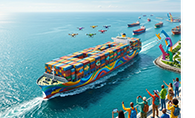 International shipping today faces a crisis of confidence. Once the great enabler of global commerce, it now struggles under the weight of overcapacity, regulatory excess, and wavering demand from its traditional consumer bases in America and Europe. To restore shipping to good health, we must return to the principles that made it thrive: freedom of the seas, the natural balance of supply and demand, and a society that values productive work and the exchange of goods across oceans. International shipping today faces a crisis of confidence. Once the great enabler of global commerce, it now struggles under the weight of overcapacity, regulatory excess, and wavering demand from its traditional consumer bases in America and Europe. To restore shipping to good health, we must return to the principles that made it thrive: freedom of the seas, the natural balance of supply and demand, and a society that values productive work and the exchange of goods across oceans.
For centuries, shipping has been the lifeblood of civilisation. Men and women alike have depended on the movement of goods to sustain families, communities, and nations. At its core, shipping requires one simple condition: demand for goods produced in one place and consumed in another. In the last century, America and Europe provided the markets, Asia the factories, and the rest of the world the raw materials. That balance created prosperity. Today, however, the system falters.
The immediate challenge is overcapacity. Too many ships chasing not enough cargo. Asian producers still manufacture, but their traditional customers in Europe and America lack the purchasing power to absorb the volumes that once justified vast fleets of containerships. This imbalance was aggravated by the Covid years.
Between 2020 and 2023, shipping companies enjoyed windfall profits as supply chains were disrupted by sudden bureaucratic decrees. Ports closed, factories halted, and transport facilities froze. In response, shippers moved cargo at a frantic pace, driving up freight rates and profits.
Flush with cash, carriers reinvested in new tonnage rather than surrender profits to taxation. The result was a shipbuilding spree. Pre‑Covid, a 10,000 TEU vessel was considered a giant. Today, 9,000 TEU ships are mid‑sized, and 24,000 TEU behemoths ply the seas. The expansion of the Panama Canal in 2016 raised the transit limit from 4,500 TEU to 14,000 TEU, opening the way for larger vessels on the Asia–US East Coast route. The industry has come a long way since the 1960s, when 500-TEUers pioneered an amazed world.
This surge in capacity might have triggered an immediate collapse in freight rates, but geopolitical turmoil intervened. Houthi attacks on shipping in the Red Sea, targeting vessels linked to Israel, forced carriers to divert around the Cape of Good Hope. The longer voyage required more ships to maintain schedules, temporarily absorbing excess capacity. Yet this reprieve is fragile. Many of the new vessels are in excellent condition and not ready for scrapping, leaving lay‑ups as the only mitigation.
Beyond overcapacity lies a deeper issue: the macro problem of societal imbalance. Shipping depends on societies that value work, production, and trade. When bureaucrats impose top‑down social engineering - whether in the guise of communism, deep‑state regulation, or fashionable green agendas - the natural balance of supply and demand is distorted. Covid lockdowns, Net Zero mandates, and renewable energy schemes have burdened economies with debt and taxation, undermining the very markets shipping relies upon.
The solution lies not in more regulation but in freeing markets. Bottom‑up reforms, already stirring in the United States and parts of Europe, promise to unleash productive energy. As restrictions are lifted, masculine free‑market forces - competition, innovation, and risk‑taking - can restore vitality. Shipping thrives when societies reward work and consumption, not when they stifle them with bureaucratic decrees.
History offers guidance. The closure of the Suez Canal after the 1967 Six Day War forced tankers to round Africa, ushering in the era of the supertanker. Today, containerships dominate, but the principle remains: shipping adapts when markets demand it. The Cape route, though longer, has temporarily balanced supply and demand. Yet lasting health requires more than detours. It requires societies that generate demand for goods and allow shipping to meet it freely.
The West Africa example is instructive. Civil wars once saw men maim each other in endless strife. Peace began to take root when men sought work to provide for women and families, buying goods that shipping delivered. At its core, shipping is about human relationships: men and women creating households, communities demanding goods, and ships carrying those goods across oceans. When societies lose sight of this, shipping falters.
Restoring shipping to good health means restoring freedom, freedom of the seas, freedom of markets, and freedom from bureaucratic overreach. Overcapacity will ease as demand revives, but only if societies embrace work and consumption rather than regulation and debt. The macro problem requires a cultural shift: away from top‑down control and toward bottom‑up vitality.
Opposition to the current course is growing. Despite compliant media, popular resistance to green mandates and wokery is rising. In many countries, parties challenge the deep‑state consensus, seeking to drop costly energy agendas and restore economic freedom. If successful, these reforms will not only revive shipping but reinvigorate economies worldwide.
Shipping is too important to be left to bureaucrats. It is the artery of global commerce, the bridge between producers and consumers, the enabler of prosperity. To restore it, we must return to the freedom of the high seas and the freedom of markets. Only then will ships sail with purpose, carrying goods demanded by societies that value work, family, and trade. |